At a Glance
- Led Analytics and ML for global expansion of the Facebook UMD-CTIS COVID-19 survey program during peak pandemic response.
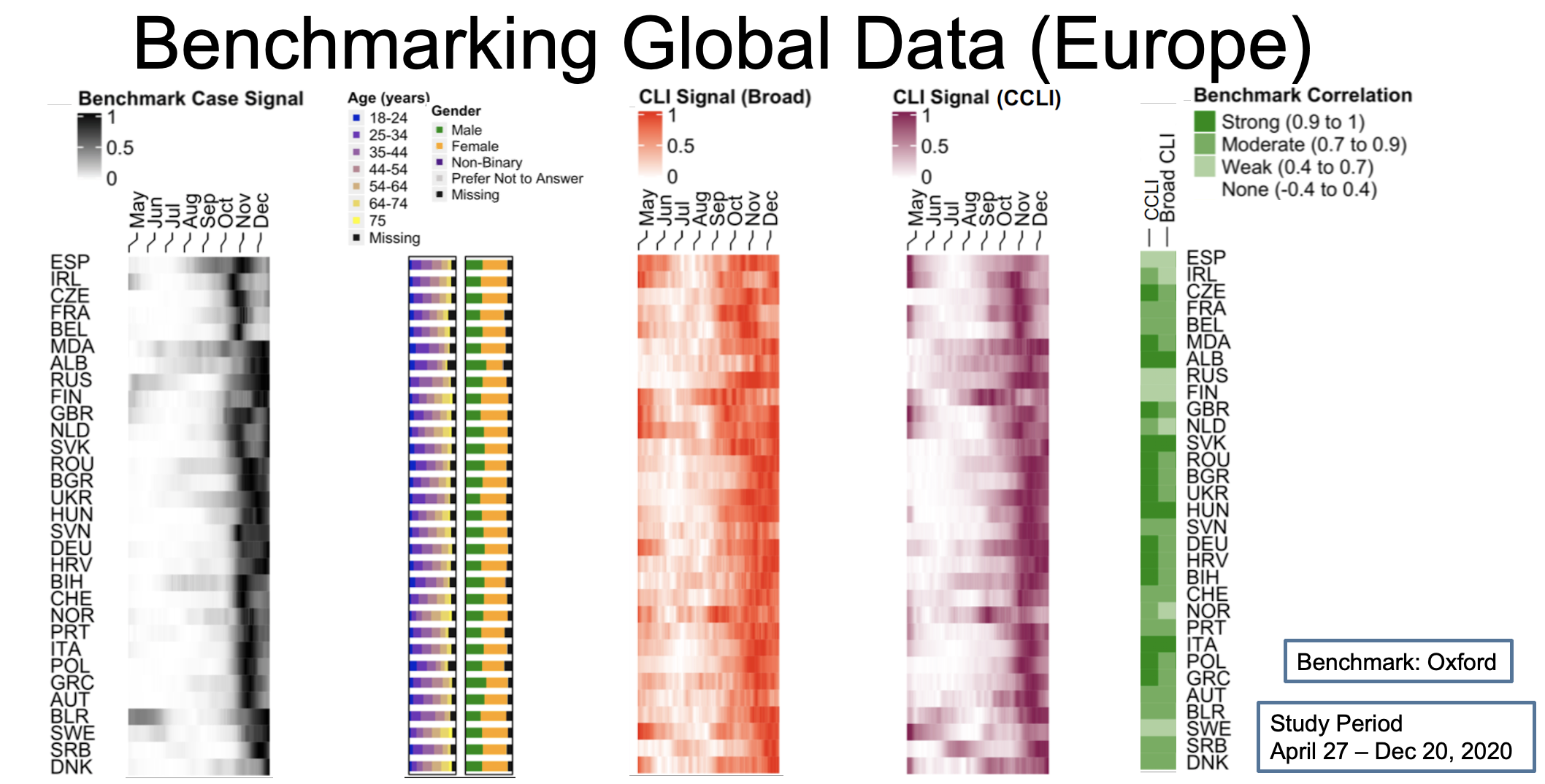
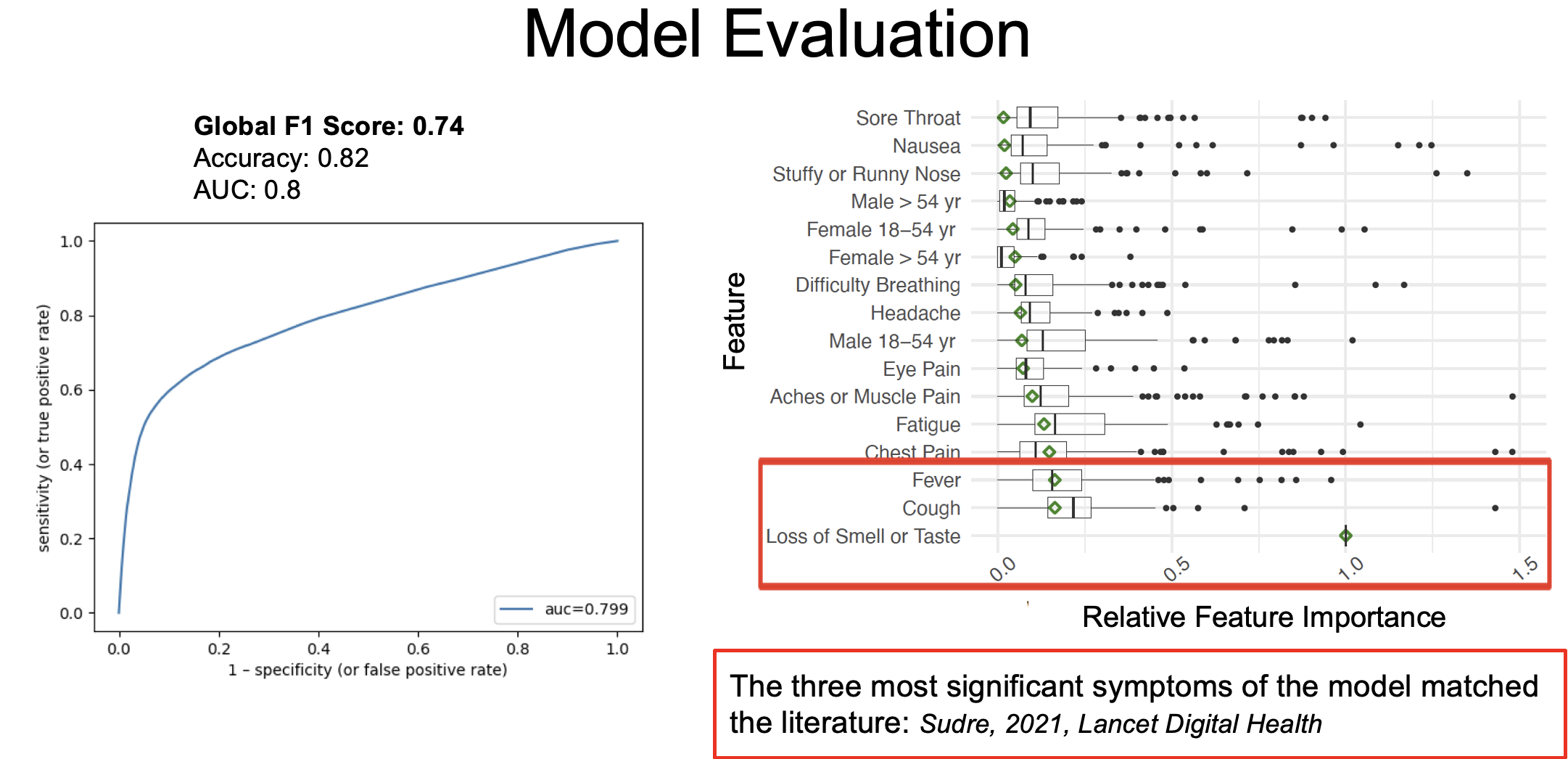
- Benchmarked CTIS signals against public health metrics for 114 countries and built ML models to predict COVID-19 postive tests.
- Partnered with academia and governments to translate survey intelligence into actionable decisions.
Visual highlights
The Problem
- Official reporting lagged or was inconsistent across countries, obscuring emerging hotspots.
- Uneven data quality made cross-country comparisons difficult for global health leaders.
- Policymakers needed privacy-conscious ways to leverage social survey data without compromising respondents.
The Solution
- Scaled sampling, weighting, and translation operations to reach billions of daily impressions in dozens of languages.
- Built analytics that benchmarked survey signals against public health metrics to validate usefulness in real time.
- Implemented stringent privacy, security, and quality controls so partners could act on insights with confidence.
Architecture Overview
- Established a federated network of survey partners, data pipelines, and governance policies covering 114 countries.
- Automated ingestion, weighting, and anomaly detection using Python and R, with Bayesian approaches to correct sampling bias.
- Developed comparison dashboards that aligned survey metrics with epidemiological benchmarks and vaccination data.
- Embedded privacy safeguards—secure aggregation, suppression thresholds, and QA protocols—before releasing any dataset.
- Coordinated localization, QA, and partner feedback loops to continuously refine question wording and signal fidelity.
Results and Impacts
- Provided near real-time pandemic metrics adopted by WHO, CDC, and national agencies for situational awareness.
- Validated survey indicators against case data, proving policy relevance for mask mandates, reopening, and vaccine planning.
- Guided resource allocation and messaging campaigns through shared dashboards and rapid partner briefings.
Skills and Tools Used
| Technique/Skill | Tools/Implementation |
|---|---|
| Skill/Tool Category | Application in Global COVID-19 Impact Monitoring |
| Global Program Leadership | Co-led the Meta/UMD survey consortium, aligning academic, industry, and government partners across 114 countries. |
| Analytics & Weighting | Applied Python, R, and Bayesian weighting to correct sampling bias and track indicators with statistical rigor. |
| Survey Infrastructure | Scaled translation, sampling, and delivery logistics so surveys reached billions of impressions daily. |
| Privacy & Governance | Implemented secure aggregation, suppression thresholds, and QA reviews prior to data sharing. |
| Stakeholder Engagement | Produced daily dashboards and partner briefings that turned survey signals into actionable public health guidance. |
Cross-Project Capabilities
- Demonstrated the ability to operationalize privacy-aware analytics at global scale, informing later federated studies.
- Strengthened skills in coordinating cross-sector partners—experience reused in vaccine hesitancy and biosurveillance projects.
- Built reusable pipelines for comparing novel survey signals with official metrics, now applied across other health domains.
Published Papers/Tools
- Daily dashboards and API feeds powering WHO, CDC, and national COVID-19 situational awareness products.
- Technical briefs documenting weighting, privacy, and quality controls shared with academic and governmental partners.
- Co-first authored publications and public reports demonstrating the program’s methodology and policy impact.Paper