At a Glance
- Analyzed billions of anonymized human movement records worldwide to understand mobility patterns during public health crises.
- Applied differential privacy techniques to share aggregate mobility insights without exposing individual data.
- Supported epidemiological modeling and policy-making by providing one of the first global human mobility datasets for research use.
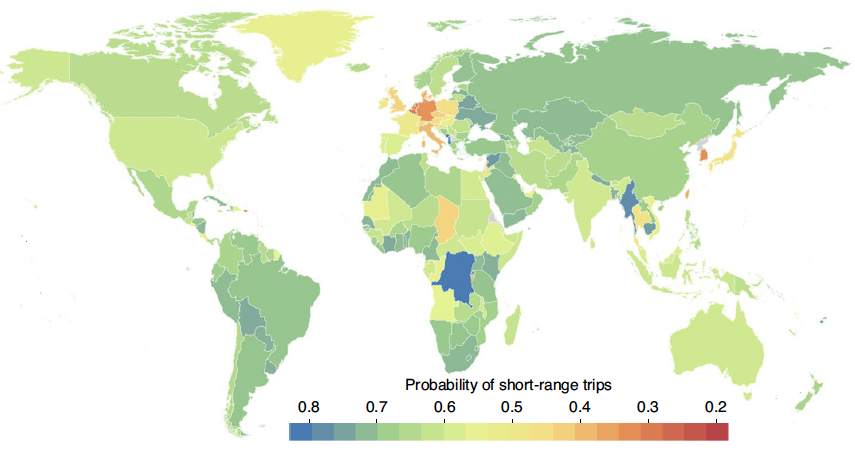
Visual highlights
The Problem
- Lack of global movement data made it hard to model disease spread and the impact of interventions (travel bans, lockdowns) across countries.
- Traditional mobility data (travel surveys, limited telecom data) were too sparse or delayed for guiding real-time pandemic response.
- Policymakers needed timely, privacy-safe insights on how populations move during crises (like COVID-19) to inform decisions, but such data was not readily available.
The Solution
- Partnered with tech platforms to aggregate smartphone location data into population mobility metrics, while ensuring individual identities were removed or anonymized.
- Implemented differential privacy and anonymity checks so that mobility trends could be analyzed and shared without compromising personal privacy.
- Generated standardized mobility indicators (e.g., distance traveled, visitation frequency, travel between regions) that could feed into epidemic models and help evaluate the effect of policies like lockdowns or reopenings.
Architecture Overview
- Data Aggregation: Collected massive location datasets from mobile apps and services, consolidating billions of GPS pings into a unified analysis pipeline.
- Privacy-Preserving Analytics: Incorporated differential privacy algorithms (adding calibrated noise to outputs) to ensure no individual’s movement could be re-identified from the aggregated results.
- Geospatial Processing: Computed movement flows and distance distributions by region, using spatial indexing and clustering to characterize typical travel radii and patterns.
- Modeling Module: Fitted statistical models (e.g., power-law decay curves for travel distance vs frequency) to quantify mobility behaviors and how they changed under interventions.
- Data Delivery: Released the processed mobility metrics via public data repositories and interactive dashboards, allowing researchers and policymakers worldwide to access and use the insights in near real time.
Results and Impacts
- Released an anonymized global mobility dataset covering dozens of countries, which became a valuable resource for epidemiologists and urban planners (e.g., used in COVID-19 transmission models and policy simulations).
- Showed how human movement dramatically dropped during early COVID-19 lockdowns and gradually rebounded; these findings validated the impact of interventions and helped authorities plan reopening strategies.
- Demonstrated a successful collaboration between industry and academia to share big data responsibly for public good, setting a precedent for future data-sharing initiatives in public health and emergency management.
Skills and Tools Used
| Technique/Skill | Tools/Implementation |
|---|---|
| Big Data Processing | Cloud-based pipeline managing billions of location records |
| Geospatial Analysis | Spatial algorithms for mapping and quantifying movement patterns |
| Privacy Engineering | Applied differential privacy techniques to protect individual data |
| Statistical Computing | R and Python for modeling mobility trends and validating results |
| Collaboration | Coordinated with tech companies and research teams for data sharing |
Cross-Project Capabilities
- Large-Scale Data Mastery: Handling multi-billion record datasets sharpened skills useful for any big-data project (from national security to large health systems).
- Privacy by Design: Experience implementing privacy safeguards (like differential privacy) translates to managing sensitive data in healthcare and other domains.
- Cross-Sector Collaboration: Coordinating with corporate data providers and academics in this project mirrors partnerships leveraged in other initiatives (big tech, government, and research).
Published Papers/Tools
- Global mobility findings published in Nature Human Behaviour (2020), providing novel insights into worldwide movement patterns (co-authored by Dr. Tuli). Paper
- An anonymized mobility dataset was publicly released with the study, enabling other researchers and policymakers to utilize global movement data for pandemic planning.