At a Glance
- Investigated a “Man-On-The-Loop” approach for supervising autonomous agent teams in an ISR mission.
- Used high-level cultural parameters (e.g., risk aversion, individualism) as global control inputs.
- Demonstrated that adjusting these group traits significantly influenced collective behavior and mission success.
Visual highlights
The Problem
- Individual oversight of large agent teams is impractical in time-critical ISR scenarios.
- Direct micromanagement cannot scale, creating the need for new high-level control methods.
- No existing method allowed indirect influence on group behavior via global parameter tuning.
The Solution
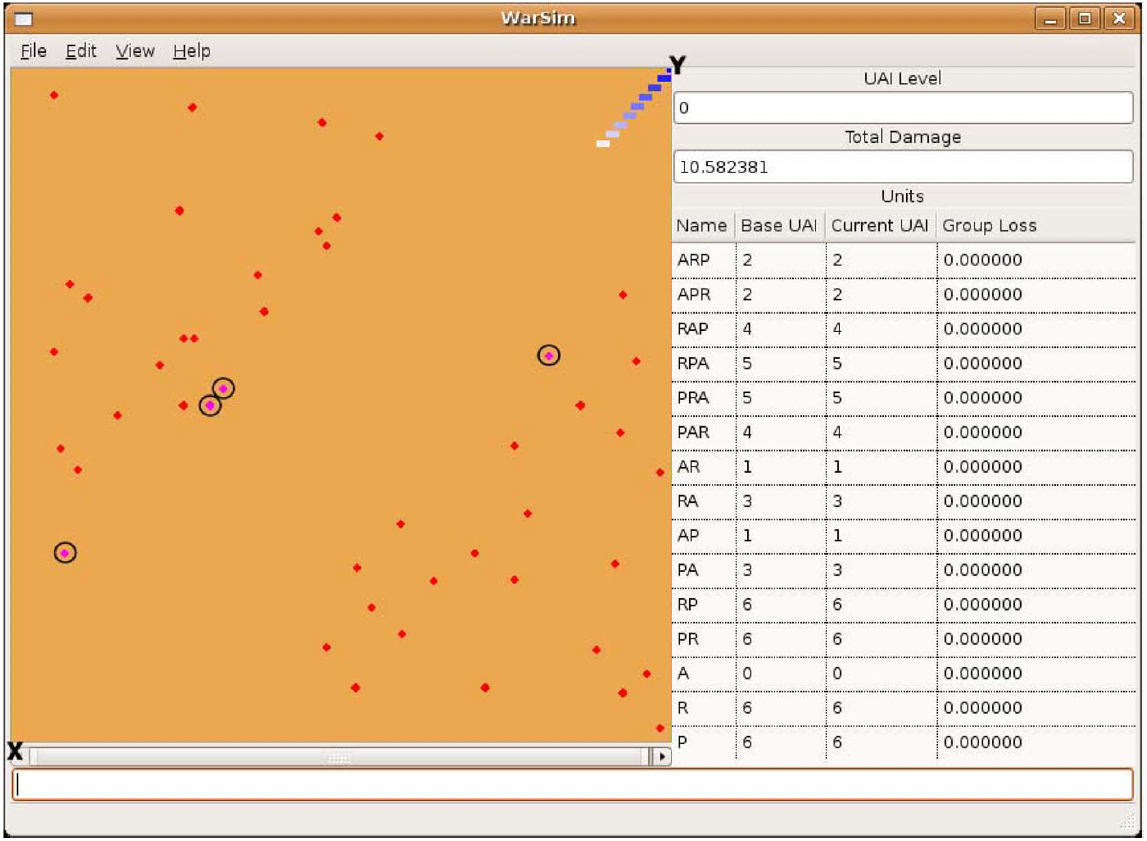
- Built a custom agent-based simulation to test the MOTL concept in a surveillance mission.
- Modeled two cultural dimensions (uncertainty avoidance and individualism) affecting all agents’ decisions.
- Provided a user interface for adjusting trait sliders and observing group performance in real time.
Architecture Overview
- Simulated a team of autonomous agents on a mission with adjustable cultural parameters.
- Implemented a supervisory console where the operator could adjust global trait values.
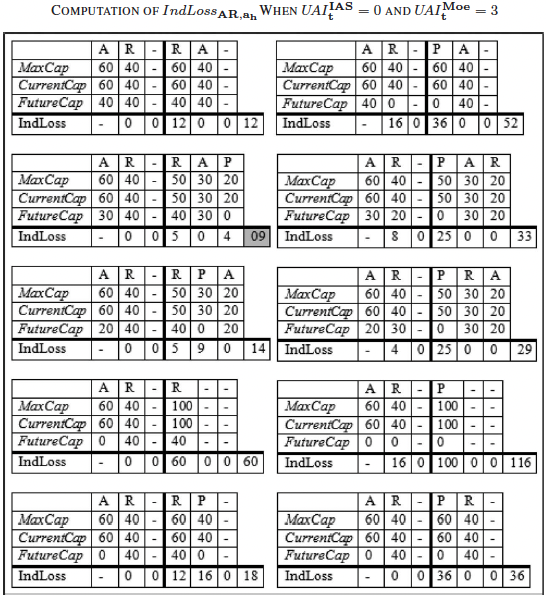
- Tracked group and individual performance metrics to evaluate each trait configuration.
- Agents followed utility-based norms that enabled cooperative, group-oriented behavior.
- A front-end dashboard visualized updated state metrics as parameters changed.
Results and Impacts
- Small trait adjustments caused significant shifts in team behavior and mission outcomes.
- Validated the MOTL approach: global parameter changes steered agents effectively without low-level commands.
- Operators learned trait–outcome relationships and tuned parameters to improve coordination.
Skills and Tools Used
| Technique/Skill | Tools/Implementation |
|---|---|
| Multi-agent simulation | Custom testbed development |
| Cultural modeling | Hofstede cultural dimensions |
| Optimization analysis | Utility theory, Pareto rules |
| Data analysis | Statistical analysis of simulation outputs |
| Research and collaboration | Academic writing (IEEE publication) |
Cross-Project Capabilities
- Introduced the MOTL supervision concept, which shaped later multi-agent control research (MAS-2).
- Developed agent-based modeling techniques applied to other domains (human factors, robotics).
- Combined AI with social science modeling, an interdisciplinary approach reused in other projects.
Published Papers/Tools
- Published "Influencing Agent Group Behavior by Adjusting Cultural Trait Values" at IEEE Trans. SMC-B.Paper
- Prototype multi-agent simulation platform for MOTL experiments (USAF-funded research tool).