At a Glance
- Analyzed ~852K patient experience tweets (2013–2016) to examine racial/ethnic sentiment trends and ACA impact.
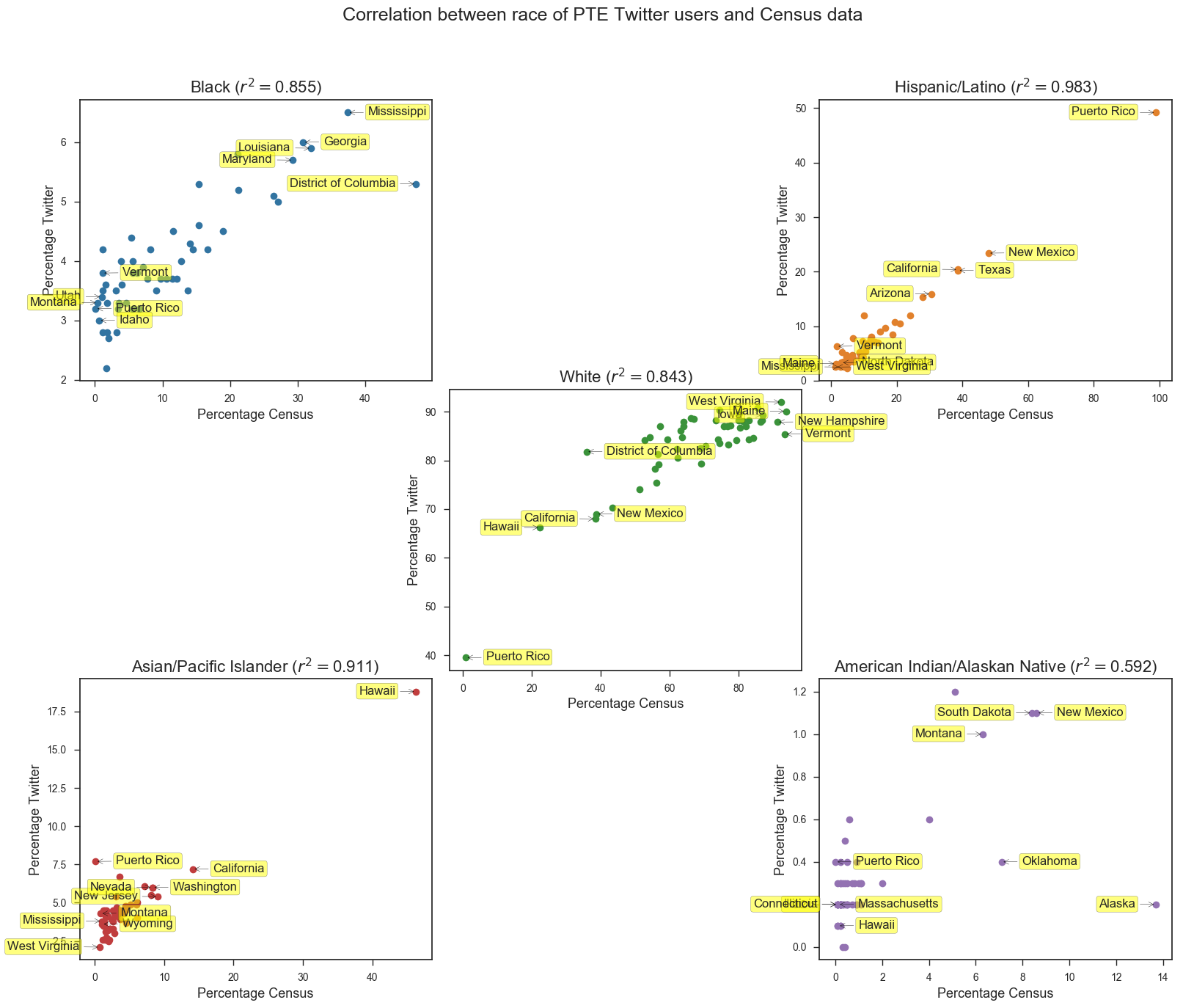
- Verified that Twitter’s user race distribution closely matches the U.S. population, allowing robust group comparisons.
- Found all groups’ sentiment improved over time; Hispanic/Latino users had the largest gain and Black users the largest post-ACA boost.
Visual highlights
The Problem
- Minority patient experiences are underrepresented in surveys, masking disparities in feedback.
- Without inclusive data, health systems struggle to identify patient experience gaps in minority communities.
- Policymakers lacked timely tools to evaluate if reforms like the ACA reduced care disparities.
The Solution
- Filtered and analyzed 851,973 geolocated patient experience tweets (2013–2016) with inferred user race/ethnicity.
- Verified Twitter’s racial composition (r²=0.99 with Census) to confirm validity.
- Classified tweets by inferred race/ethnicity and computed yearly average sentiment per group with regression analysis to detect trends and ACA effects.
Architecture Overview
- Extracted tweets from users with identifiable race/ethnicity and US location.
- Applied algorithms to infer each user’s racial/ethnic group (validated against Census data).
- Used previously labeled tweet sentiments (positive/neutral/negative) for analysis.
- Aggregated sentiment per group per year and applied regression to measure changes pre- vs post-ACA.
Results and Impacts
- Twitter’s racial/ethnic distribution mirrored the U.S. population, confirming data representativeness.
- All groups’ average sentiment became more positive from 2013 to 2016.
- Hispanic/Latino users’ sentiment improved the most (1.5× the gain of White users); post-ACA, Black users’ sentiment rose 2.2× more than White users’.
- These findings suggest ACA implementation coincided with improved experiences for minority patients.
Skills and Tools Used
| Technique/Skill | Tools/Implementation |
|---|---|
| Demographic inference | Algorithms to assign race/ethnicity to users |
| Statistical modeling | Regression analysis of sentiment trends |
| Public policy analysis | Interpreting ACA impact through data |
| Big data handling | Processing nearly 1M tweets with multiple attributes |
| Collaborative research | Work with epidemiologists; journal publication |
Cross-Project Capabilities
- Built on the earlier patient experience pipeline, demonstrating scalability to demographic analysis.
- Combining social data with demographic inference is a model for evaluating policy impacts in other domains.
- Emphasized equity-focused analytics, aligning with other projects targeting vulnerable groups.
Published Papers/Tools
- Racial and Ethnic Disparities in Patient Experiences in the United States: 4-Year Content Analysis of Twitter (J. Med. Internet Res. 2020). Paper
- Developed an analytical framework for social media-based health disparity research.
- Shared findings with public health stakeholders to inform ACA evaluation.