At a Glance
- Introduced a multi-stage contagion model for smoking that incorporates addiction and resistance.
- Found that addiction creates a “structured resistance,” making smoking persist longer.
- Explained the slow decline in smoking rates by showing that once endemic, eradication becomes very difficult.
Visual highlights
The Problem
- Standard epidemic models predicted quick smoking eradication, contrary to real slow declines.
- Real-world data show smoking rates fell only gradually over decades.
- Existing models ignored nicotine addiction, failing to capture persistent smoking dynamics.
The Solution
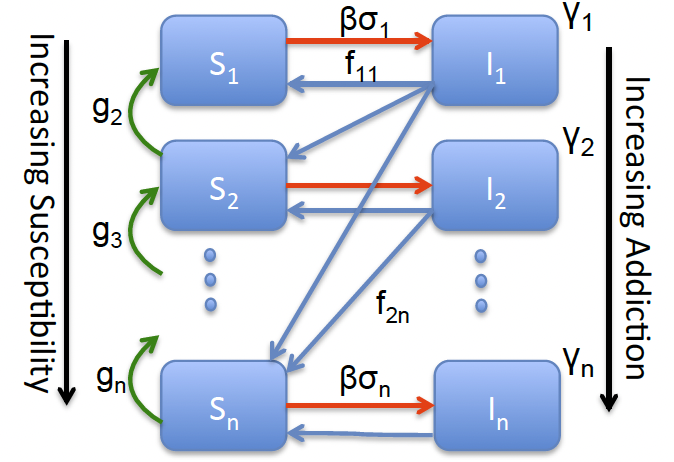
- Extended the classic SIS epidemic model with multi-level addiction and resistance states.
- Created a “structured resistance” model where quitting raises an individual’s susceptibility to relapse.
- Validated the model with simulations on longitudinal social network data (Framingham Heart Study).
Architecture Overview
- Multi-level contagion model with multiple Susceptible (S1…Sn) and Infected (I1…In) states by addiction level.
- Quitting raises an individual’s susceptibility tier, reflecting higher relapse risk after quitting.
- Sustained abstinence can slowly lower susceptibility over time, modeling gradual recovery.
Results and Impacts
- The model exhibits backward bifurcation: once smoking is endemic, it is very hard to eradicate.
- Simulated smoking trends closely matched the empirically observed slow historical decline.
- Concluded that ending the smoking epidemic requires substantially greater effort due to addiction effects.
Skills and Tools Used
| Technique/Skill | Tools/Implementation |
|---|---|
| Network epidemic modeling | Custom contagion models with addiction levels |
| Social network simulation | Framingham longitudinal data simulation |
| Mathematical analysis | Epidemic threshold and bifurcation theory |
| Data interpretation | Matching model output to public health trends |
Cross-Project Capabilities
- Developed a multi-level contagion framework applicable to other addiction-like behaviors.
- Insights on threshold dynamics informed intervention strategy designs in later projects.
- Provided groundwork for targeted network interventions (edge-removal methods) in subsequent work.
Published Papers/Tools
- Addiction Dynamics May Explain the Slow Decline of Smoking Prevalence (LNCS, 2012). Paper
- Introduced the Structured Resistance Model concept for “policy-resistant” problems.
- Integrated findings into social simulation platforms for public health policy experimentation.